Wednesday, October 13, 2010

Hiroshima Castle and Hiroshima Gokoku Shrine


Hiroshima Castle, sometimes called Carp Castle, is five stories tall and its grounds are surrounded by a moat. There is a shrine on the grounds, as well as one main gate. Hiroshima developed as a castle town, whereby the castle was both the physical center of the city and the source of its prosperity.

Built in 1589 by the powerful feudal lord Mori Terumoto, Hiroshima Castle was an important seat of power in Western Japan. It was spared the destruction that many other castles met during the Meiji Restoration, and survived into the modern era. Unfortunately, like the rest of the city, Hiroshima Castle was destroyed by the atomic bomb in 1945.

Rebuilt after the war, Hiroshima Castle's wooden exterior makes it a reconstruction with a considerable semblance of authenticity. Inside the castle is a small but informative museum on Hiroshima's history, Hiroshima Castle, and Japanese castles in general.


Hiroshima Gokoku Shrine


This little boy was turning 5 and his parents brought him to the temple, when the children turn 3 and 5 here they bring them to the temples. This man gave each of us a free charm, once again showing how giving the Japanese people are.


Another part of the castle.


On the way out we stumbled upon a wedding getting ready to take place, so of course I raced over and got a picture.


Tuesday, October 12, 2010

Hiroshima Peace Memorial Museum

This was the hardest part for me, no matter what your take on the war, what these people suffered is so sad to me and makes me very emotional. I still have not made it to the museum in Nagasaki. I was doing alright in the museum passing by things rather quickly, we came upon this exhibit where you can see a booming and well built city next you move onto the next exhibit and everything is completely gone Kayleigh looks up at me and says " Mommy what happened" how do you explain that to your 3 year old? Needless to say we hurriedly passed through the exhibits and out the door.

According to the introduction in the Hiroshima Peace Memorial Museum's English guide: "The Peace Memorial Museum collects and displays belongings left by the victims, photos, and other materials that convey the horror of that event, supplemented by exhibits that describe Hiroshima before and after the bombings and others that present the current status of the nuclear age. Each of the items displayed embodies the grief, anger, or pain of real people. Having now recovered from the A-bomb calamity, Hiroshima's deepest wish is the elimination of all nuclear weapons and the realization of a genuinely peaceful international community."[1]

To facilitate education, the museum was renovated in 1994 and is now divided into two sections.

The East Wing — the newest addition — explains the history of Hiroshima City before the bomb, development and decision to drop the bomb, the lives of Hiroshima citizens during World War II and after the bombing, and ends with information about the nuclear age and efforts for international peace. Included in this section is a model showing the damage done to the city.

The West Wing, which was part of the old museum, concentrates on the damage of the bomb. Sections include Material Witness, which shows clothing, watches, hair, and other personal effects worn by victims of the bomb; Damage by the Heat Rays, a section that looks at what happened to wood, stone, metal, glass, and flesh from the heat; Damage by the Blast, focusing on the destruction caused by the after shocks of the blast, and Damage by the Radiation which goes into details about the health effects suffered by humans.


Kayleigh and Ben giving their offering.


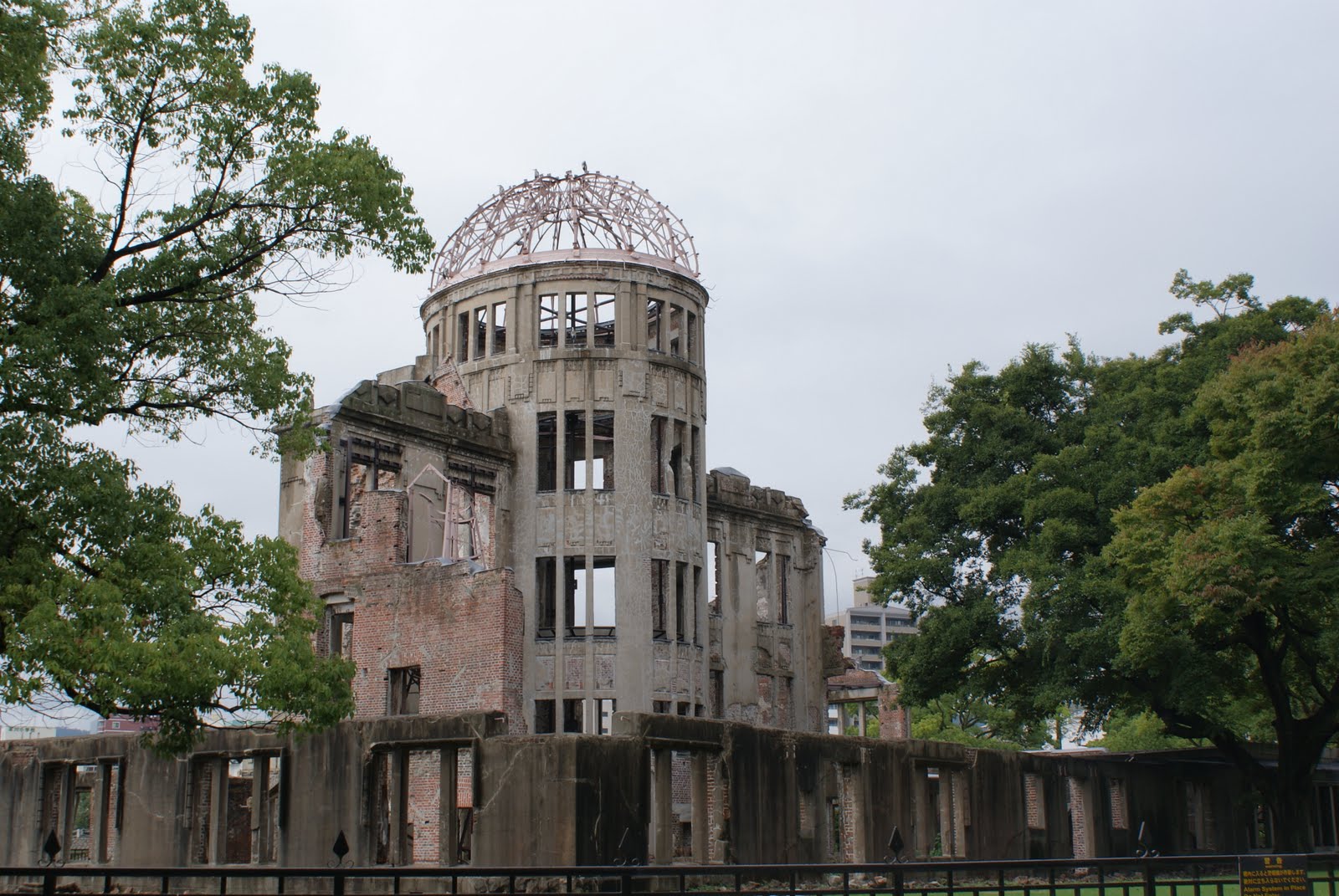
Hiroshima Atomic Bomb Dome

Hiroshima Peace Memorial, commonly called the Atomic Bomb Dome or A-Bomb Dome in Hiroshima, Japan, is part of the Hiroshima Peace Memorial Park and was designated a UNESCO World Heritage Site in 1996. The building serves as a memorial to the people who were killed in the atomic bombing of Hiroshima on August 6, 1945. Over 70,000 people were killed instantly, and another 70,000 suffered fatal injuries from the radiation.


Having slightly missed the original target (the distinctive "T"-shaped Aioi Bridge), at 8:15 on August 6, 1945, the first nuclear bomb to be used in war, detonated almost directly above the dome (the center of the blast was 490 feet (150 m) away and 1,968 feet (600 m) above ground).

The Genbaku Dome, originally close to Shima Surgical Clinic, initially was scheduled to be demolished with the rest of the ruins, but the fact that it mostly was intact delayed these plans. As Hiroshima was rebuilt around the dome, it became a subject of controversy; some locals wanted it torn down, while others wanted to preserve it as a memorial of the bombing.[2]

In 1966 Hiroshima City declared that it intended to preserve the now termed "A-bomb Dome" indefinitely.


Friday, October 1, 2010

Our food Findings

Last weekend was a fun Filled weekend Saturday we headed off to Fukuoka and spent the whole day there, we left here at 9am and didn't get back till 10pm, then woke up Sunday morning and heading out to Shimabara and Unzen along with Obama Town for another fun day getting home about 7pm. Enjoy all the pictures, if you have Facebook look me up cause there are 482 pics from this weekend on there. Love you all We are picky eaters compared to a lot of people here but since being here I've opened up a lot more to what I can eat. Here is what we had throughout the day poor Kayleigh had fries for 2 days, thankfully we were able to come across a McDonald's for her on Sunday so she could get some meat in her.


Kokura Castle, Japanese Tea Garden


Kokura Castle, the only castle left standing in Fukuoka Prefecture, was first built in 1602 by Hosokawa Tadaoki and completed six years later. The castle was destroyed by fire in 1837, with parts of it rebuilt by 1839. The castle was damaged again in the violent times leading up to the Meiji Restoration in 1868, this time in fighting between the pro-imperial forces of the Choshu clan and the Tokugawa-allied Kokura clan in 1865. Kokura Castle's donjon (keep) was rebuilt in 1959 and the castle buildings completely resored in 1991


Shrine area behind the castle walls.


This area is a genuine Chisen Kaiyushiki style garden.This is a samurai-style mansion called a shitayashiki or second house that served as the castles annex. This was the property of the Ogasawara family which reined in the Kokura area


Hobashira Cable Lift

Hobashira Cable-is the name of Japanese funicular line, as well as its operator. The line climbs Mount Sarakura in Kitakyūshū, Fukuoka. The line does not have any official name. It opened in 1957. This is also the longest cable railway in Kyushu, with a sky lift that carries the passengers to the summit, which offers a 360-degree panoramic view