Thursday, October 14, 2010

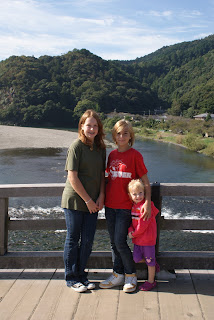
Kintaikyo (Bridge)

So this past weekend Sallie and I loaded all 6 kids in a van and headed to Iwakuni ( Marine Base) we had an awesome drive up and after a few bumps at check in got to our rooms. Which were really nice and big. The girls and I had 2 rooms with a full kitchen, much nicer than the Lodge here. The best part about traveling this past weekend was Iwakuni has a Burger King!!!! a Pizza Hut!!!! and an American KFC. The girls and I were super excited as we are a burger king family :) The girls had friday and monday off so we made it a 4 day weekend and enjoyed being back on a Marine Base for a couple of days. Enjoy the pictures :)


Kintai Bridge spans Nishiki River which once separated the samurai and their castle from the commoners. The bridge was a masterpiece of engineering with its 5 arches when it was first built in 1673. The bridge washed away the next year but the stronger replacement lasted until 1950 (rebuilt 1953) and became known as one of the top three classic bridges in Japan.

The current bridge was built from 2001 to 2004 but the original design and traditional tools were used to create a faithful reproduction.


Monkey Show, White Snakes and Iwakuni Castle

Girls eating Ice Cream. This monkey put on a show was very entertaining.


White Snakes of Iwakuni
Albino snakes sometimes occur in nature but generally the trait is not passed on to the offspring. Iwakuni's white snakes are unique in the world as the coloring is stable and has existed from some time. The harmless snakes reach about 180 cm long and 15 cm thick. The snakes have been given the status of a natural monument


Iwakuni-jo was built by Kikkawa Hiroie in 1608. Just a few years later in 1615 the castle was torn down to comply with the Tokugawa law of "one castle per province." The current reconstruction was placed a little bit closer to the front edge of the mountain so it could be more easily seen from below and to give visitors a better view of the valley from the castle.
History Iwakuni-jo was built by Kikkawa Hiroie in 1608.


Wednesday, October 13, 2010

Miyajima

Since ancient times, Miyajima, the island itself, has been worshipped as a god. This belief, passed down from generation to generation, has protected Itsukushima Shrine, many other shrines and temples as well as the island's unique culture, and its sacred nature. Renowned for being a world cultural heritage site today, Miyajima is an island where people and gods dwell together.


We took a ferry over to the island of Miyajima it is said to be one of Japan's 3 most scenic spots.
There are deer everywhere and they will eat anything you leave around even paper, I saw that a few times. The girls loved walking around and touching them.


When we got ready to board the little canoe Autum volunteered to carry one of the babies, she is holding Nate.
When the tide comes in the shrine is in water but when the tide goes out you can walk to the shrine. The tide was due to go out at 445pm we only stayed till 230pm.


All of us on the little canoe


Itsukushima Shrine is known for the unique and bold concept of being built in the sea as well as its elegant architectural style called “Shinden Zukuri”. It is said to have been first built in 593, and the present shrine pavilions were constructed in 1168. The vermilion-painted main building creates a beautiful contrast with the blue sea and green mountains; when the tide comes in, the shrine looks as if it is floating on the sea. This historical piece of cultural heritage stands in perfect harmony with its natural surroundings.

"Miyajima" means "shrine-island" in Japanese, referring to the island's cause of fame, Itsukushima Shrine. The shrine is known worldwide for its "floating torii gate".

The shrine and its torii gate are unique for being built over water, seemingly floating in the sea during high tide. The shrine complex consists of multiple buildings, including a prayer hall, main hall and a noh theater stage, which are connected with each other by boardwalks and are all supported by pillars above the sea


Pagoda's are one of my favorite things to capture on photo here.


Itsukushima Shrine, when the tide goes out so does all this water.


Some of the things you could get to eat on the island.


Kayleigh and Ben


Long line to get back on the ferry.


Children's Museum

The kiddos on the way back to Iwakuni, the little ones were all asleep within 10 minutes of us heading back. This train was beside the Children's Museum.


These 2 Japanese girls followed Autum everywhere until we left.


Playing in the science adventure gymnasium


This childrens museum was free and a great way to end the day.


Hiroshima Castle and Hiroshima Gokoku Shrine


Hiroshima Castle, sometimes called Carp Castle, is five stories tall and its grounds are surrounded by a moat. There is a shrine on the grounds, as well as one main gate. Hiroshima developed as a castle town, whereby the castle was both the physical center of the city and the source of its prosperity.

Built in 1589 by the powerful feudal lord Mori Terumoto, Hiroshima Castle was an important seat of power in Western Japan. It was spared the destruction that many other castles met during the Meiji Restoration, and survived into the modern era. Unfortunately, like the rest of the city, Hiroshima Castle was destroyed by the atomic bomb in 1945.

Rebuilt after the war, Hiroshima Castle's wooden exterior makes it a reconstruction with a considerable semblance of authenticity. Inside the castle is a small but informative museum on Hiroshima's history, Hiroshima Castle, and Japanese castles in general.


Hiroshima Gokoku Shrine


This little boy was turning 5 and his parents brought him to the temple, when the children turn 3 and 5 here they bring them to the temples. This man gave each of us a free charm, once again showing how giving the Japanese people are.


Another part of the castle.


On the way out we stumbled upon a wedding getting ready to take place, so of course I raced over and got a picture.